Burnham's theory of power
This week's Friday notebook

Good morning. Many congratulations to my nine French subscribers. Though perhaps you’re Brits who live in France, in which case commiserations. Unless you’re Scottish, in which case enjoy France beating England in the final. I don’t have any subscribers in Morocco, which is weird, because in Rabat they speak of little else but Huey Long and Edmund Dell.
Anyway, my column in this morning’s Times isn’t about Nigel Farage, of whom more shortly, but Andy Burnham. Nominated for the Labour leadership by 322 Labour MPs as of last night – 80 per cent of them! – we now know he will be prime minister and so the frantic and tenuous conjecture about what he might think will now kick up a gear over the ten days that separate us from the first England appearance in World Cup final in 60 years and our first wool prime minister ever. So I’ve written about what he does think.

As I say in the column, one of the most damning things I was ever told about Sir Keir Starmer was this – from an interview with one of his closest, indeed most admiring, advisers for the paperback edition of GET IN.
I don’t think he has a theory of power. I don’t think he’s ever sat down and read any history, or has any idea of how power works. I just don’t think he would be attracted to the kind of historical figures who got stuff done.
Burnham definitely does. Understanding it demands we once again travel at warp speed down the East Lancs Road and back into the Liverpool of the 1980s. In my Substack on his Catholicism, I noted that Burnham grew up in and around a Liverpool shaped by the subversive politics of two Dereks: Worlock, the archbishop, and Hatton, the Militant deputy leader of the city council. And he has actually spoken before of his fleeting, boyish admiration for the latter, too.
In March 2010 he made this confession to The Independent.
This might be career-limiting to say but, as a young teenager, I was very taken in by Derek Hatton who in the early 80s seemed to be on the north-west news every night taking on Maggie.
He went on to clarify that he “grew out” of this phase once he discovered Neil Kinnock. It’s worth lingering on, though, as it provides us with yet more formative context for the politics that now mean everything to Britain.
Burnham came to political sentience at a time when Margaret Thatcher was imposing hard and unyielding limits on the powers of English local government – how much money they could raise, how much of it they could spend, abolishing metropolitan county councils like Merseyside’s.
This drive for centralisation was as essential to her premiership as deregulation and privatisation, and when Burnham speaks of rolling back her legacy and with it 40 years of neoliberalism, he is speaking about this too. It was all linked, as – clearly – are the consequences and the prescription they demand in Burnham’s mind. There was a hint of this in his maiden speech as the member for Leigh in 2001, too.
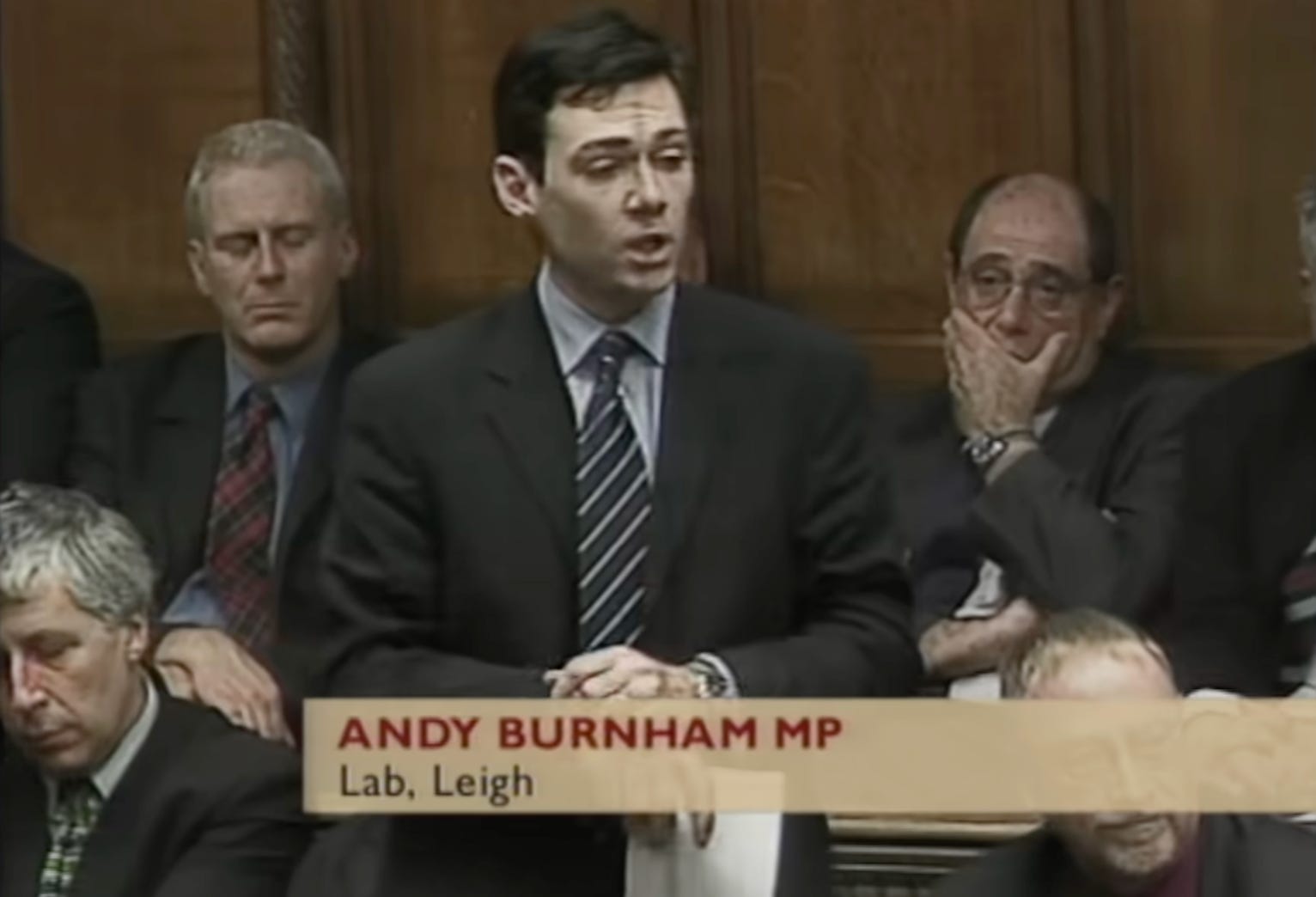
People in the Leigh area can be forgiven for having little confidence in this place. Until recently, it has delivered only bad news. Dr. Beeching put Leigh on the map —sadly, for making it the largest town in England without a railway station. Next came the closure of the mills and mines in the 1980s and 1990s, tearing the heart out of the communities based around them, and Leigh infirmary’s accident and emergency unit was closed in the 1990s. The challenge I face is to restore people’s faith in politics and show that Parliament does listen and deliver good news as well as bad.
Same as it ever was. Plus ça change. Etc. So the Burnham diagnosis, then as now, is that political and economic power are, by design, draining away from ordinary people in ordinary places and ever more powerless politicians are increasingly distrusted as a result. To this we can add his critique of whipping, on which he expounded at length – with lavish promises of change – in a very long email to Labour MPs on Wednesday. (Click here to read it in full.)
The sum of it all is this. Councils are toothless and broke. Their essential services are outsourced or cut into uselessness. They just end up frustrating the public as a result: everything’s crap and they’ve no means to make it better. The people they’d think to ask no longer have a stake or say either: in Ashton the other week, Burnham offered the example of Rochdale Boroughwide Housing, which kicked councillors off its board as soon as it was able to and then had a two-year-old, Awaab Ishak, die in a mould-infested flat on its watch. That’s why he speaks specifically of building new council housing, not social housing.
He also spoke about multi-academy trusts. Bridget Phillipson has already copped a lot of flak for trying to curb their power to set salaries, hire who they like, and pay their headteachers and executives unfathomable riches. Another example, there, of actually existing Burnhamism.
So it goes on. The Commons can’t do as much as voters assume it can because so many of its functions are outsourced too: to quangos, arm’s-length bodies, whatever. Their MP, fearful of the coercive power of this whip or that spad or someone else in No 10, might not even want to speak out anyway. If they did kick off, they’d probably end up even less likely to deliver the change their constituents wanted. Elections start to feel like a sham: what’s the point? Somebody do something!
That’s how you end up with Reform sweeping almost all before them in Wigan and St Helens barely six weeks before Burnham wins Makerfield. He’d say this was an understandable but regrettable voter reaction to the “unaccountable state”. When he said that to me, it reminded me of the title of the Hillsborough Independent Panel report he commissioned as culture secretary: The Patronising Disposition of Unaccountable Power. Because that’s the other thing. If you’re complaining about any of this, chances are you’ll just be told that you just don’t get it.
Accountability is hard, of course. People mess up, not least the PLP. Some councils aren’t up to the job of proper democratic oversight – though we might ask why that is. Several senior Labour people whose judgement I trust told me flatly his Outlook manifesto for party unity and culture change – “Let’s all be friends” was how Morgan McSweeney snarkily described Starmer’s short-lived impulses in the same direction – was undeliverable nonsense.
And sure, much of it may end up as a manifesto for merely pretending very convincingly and charmingly to listen to Labour MPs. As I was speaking to Burnham allies and critics about this on Wednesday I dredged up a column I wrote just after the Gaza rebllion kicked off in October 2023.
Lesson one: individual MPs matter. Even, as John Major put it, the dispossessed, never-possessed and the bastards. Every successful leader is at one time or another accused of high-handed autocracy. Backbenchers don’t like it when they are ignored. In the main the sensibilities of Labour MPs are conventional and conservative but when it comes to party management their preferred model would probably be the editorial collective of Spare Rib. But that is not licence to neglect them, and they are feeling neglected… in government they will want and need to feel like more than lobby fodder.
It was obvious even then that this was a big vulnerability. It wasn’t addressed until much too late. Challenging though it will be to offer in some cases, even a cursory acknowledgement of MPs’ humanity from Team Burnham would be a marked improvement on what they initially got in the early months of this government.
So yeah. It might fail. But he believes in breaking open that “unaccountable state”. Always has, and the same is true of so much of what we’re now listening to intently for the first time. The problem, as that Labour peer I mentioned in last week’s Friday Notebook said to me, is that believing is not quite the same thing as thinking.
A few things for Burnham to think – and worry – about
This letter, signed by more than 80 Labour MPs, demanding he reverse Shabana Mahmood’s controversial proposals on indefinite leave to remain. The language is robust and the subtext clear. One minister texted this response to my tweet: “How can any of the 80 serve in a government with Shabana?”
John Bew’s warning that he could face an international military crisis within weeks of taking power.
Just how quickly Starmer loyalists leapt at the opportunity to brief indignantly about Lou Haigh’s unsurprising admission to the BBC that she and Burnham had been thinking about a leadership transition for at least a year.
Accusations that ministers have artificially manipulated hospital waiting lists to meet their target of treating 65 per cent of patients within 18 weeks.
Sharon Graham breaking the habit of her lifetime at the helm of Unite and nominating a candidate in an interal election. It’s like Dylan going electric. Good news: it’s a nomination for Andy Burnham. 11 years late, but still, that one’ll taste sweet. Bad news: it comes with a long list of conditions, some of which he could struggle to meet.
But maybe none of it matters so much, given what’s happening elsewhere…
Safe refuse for Nigel?

My Times piece on Farage from earlier this week seems to put me in a fairly small minority of commentators who think a by-election in Clacton needn’t necessarily spell inevitable and crushing embarrassment for Reform UK. And, judging by your comments on the Substack I wrote subsequently, my strong aversion to Count Binface also turns out to be a rare allergy. But then again, I think Ken Dodd is funny, so I accept I’m not making an objective judgement.
That said, I was quite taken with Fraser Nelson’s Joe Dolce theory of politics: could Binface be to Farage what Shaddap You Face was to Ultravox’s Vienna?
It was heroically kept off [number one] by a popular support for Joe Dolce’s Shaddap You Face: vulgar, daft, irresistible and magnificently unserious. All very British. I’ve always see that Dolce moment as one that defines a unique part of our national character.
See also: Rage Against the Machine versus X Factor winner Joe McElderry in 2009. Anyway, after several days of listening to Binface and people talking about Binface – all of them profoundly painful – I still haven’t changed my mind. On balance I still just about think it’s Reform’s critics and particularly the Tories who stand to lose most from, as Rachel Reeves put it on Wednesday, Farage spending his summer “arguing with a bin”.
The best explanation I can give as to why I think this actually came from Justine Greening – remember her? – on LBC earlier this week. She said:
How depressing for democracy that we’re going to end up with an important by-election and the only choices are apparently going to be Nigel Farage and Count Binface. And I’m making a serious point here. There’s no point criticising Nigel Farage, as you both have done, and then not putting anyone up against him when it’s a genuine elections with real voters.
Zoe Williams from The Guardian then asked Greening what possible democratic purpose it could be serving. To which she said this.
It’s electing an MP... It’s real people, with real concerns, real votes, electing a real MP, and it’s pointless sitting in this lovely London radio studio chatting about it, and then when the actual political fight happens in Clacton, oh, we’re like, oh no, I don’t think we should really participate, it’s just a stunt. No it’s not, it’s called a by-election.
I agree. The video of this exchange is worth watching back in full. Make that woman work and pensions secretary again! Whatever you think about the motives at play, this is still a real election. I think there’s an arguable, strong but not unanswerable case that Kemi Badenoch ought to have run a candidate and taken the opportunity provided by weeks of free airtime to make the same attacks on Farage, his record and his party’s money she’s making anyway.
It’s unlikely they would have won but even slashing Reform’s share of the vote would have been hailed as a moral victory and further evidence of the national comeback so much of Westminster is trying, on patchy and inconsistent evidence, to will into existence. Arguing with a bin is one thing, ha ha ha. But am I really alone in thinking a substantive political argument would better serve the interests of the old guard, and particularly a Conservative Party that could do with more proof points for Reform’s decline?
You can understand why Badenoch didn’t rise to the bait, though. As a wise Labour official said to me on Thursday morning: “It’s not winnable for them so they shouldn’t provide a chance to prove that, but that should set more alarm bells ringing for them/the media than it seems to be.” In any case, new Sunday Times revelations about a police investigation into Reform donations suggest Badenoch will have ample opportunity to rehearse those talking points yet.
Read, digest and regurgitate

Joey D’Urso’s excellent Substack on the politics of football has pre-empted a lot of the questions I’ve found myself asking myself and others as I watch this World Cup tie or that. The above piece is a great thing to have up your sleeve in the pub or group chat over the coming days. Echo and the Bunnymen gave their first compilation of singles the hilariously grandiose title of Songs to Learn and Sing. These posts are ones to learn and pass off as your own insight.
Another recent one, on whether a majority Protestant country can win the tournament for the first time, is worth reading too. Did Brazil crash out to Norway because they’ve lost their Catholic flair in a new era of polairising Protestant evangelicalism? I’ve seen loads of people ask that question with varying degrees of seriousness on Twitter, but Joey’s is the only detailed answer I’ve read. Good fun.
Now listen
I was on the LRB podcast with James Butler and William Davies last week, discussing Burnham’s political economy and style.
Meanwhile I have a Labour Catholic to thank – or blame – for what follows. They complained that nitpicking traditionalists questioning Burnham’s claim to the faith were “modern-day Pharisees”. Which inevitably reminded me of Lord of the Dance.
Before I knew it I had this version by the Houghton Weavers on repeat and I can’t seem to make it stop. That’s the Ken Dodd cortex doing its thing again, presumably.
The late Andy Kershaw, always impossible to please, once said these guys didn’t count as proper folk musicians. Whatever they were, it’s a shame that unlike George Formby, say, or Doddy, they’ve all but disappeared from popular imagination in the north-west. Book the survivors for the Burnham Inauguration Ball.
As the Conservative candidate for Leigh in 1992 I totally agree with Andy Burnham’s words in his maiden speech you have quoted and share your hope he will change the way we are governed for the better.
I do not agree with you on Count Binface. His Dear Makerfield letter shows he is firmly committed to democratic values. A background in comedy is not necessarily a disqualification. He could be to Farage what Zelenskyy has been to Putin.
With a proper campaign - and it seems he has an offer of funding - he might
Farage has a mandate in Clacton for three more years. He wouldn't resign and stand again if he didn't think he'd win again and easily. So its not a real election, its a sham. I can't think of anything more appropriate than him up against a comedian in a daft costume calling his manipulation of his constituents out.