Friday notebook: Captain Swing and the soap factory
What I've been reading and writing this week

Good morning. Over the short lifetime of this Substack my posting schedule has been pretty spasmodic, with extended periods of abeyance I’ll blame on the long death of Keir Starmer’s government. But I’ve very much enjoyed writing here more regularly in the past couple of weeks and my always illuminating interactions with subscribers have stiffened my resolve to keep it up.
So hold me accountable on this one. I’ve decided to send out a weekly newsletter at around this time every week. Most of what I’ve written here has been long and essayistic, adding context and commentary to my pieces in The Times. I’ll still be doing that as often as I feel like it, but much of what I read and write doesn’t really justify that treatment.
Here you can expect to find my Friday Times column, good – better? – work from colleagues, reflections on the week in Westminster, and whatever else I’d like to recommend that’s probably too eccentric for the day job. Anyway, let me know what you think of this experiment in the comments.
This week’s column
There may be trouble ahead for Andy Burnham, I write in my Times column today.

For now, everyone is at least pretending it’s going to be great. It’s as if the Labour Party is infected with Burnham Magnanimity Syndrome. “I feel optimistic about it,” Morgan McSweeney told Nick Robinson yesterday.
This is the same Morgan McSweeney who was described to me, the week after the local elections, as having “contempt for Andy” by someone who knows him very well. He is, however, a Labour tribalist – he even said U2’s With or Without You reminds him of his umbilicial relationship with the party – so let’s credit him with a degree of sincerity. In any case, the column isn’t about McSweeney, but the people he left behind.
In private it does not take long for conversations with recusant Starmerites to turn to the reasons why Burnham’s premiership won’t be great. The very existence of that former group of people, who feel angry and defrauded and humiliated and hopeless for the future, is one of them. They are straining to remain loyal, not least because they feel Burnham and his enablers in cabinet showed no loyalty to them. But they will need very little excuse to kick off.
It’s broader than that, though. As I write this morning – subscribe to The Times to read the full piece – there are geographic and demographic grievances too. MPs from London and the southeast don’t like the cut of Burnham’s gib. They think his rhetoric elides poverty and deprivation in the south a little too readily and glibly.
It’s notable that some are already saying this in public. Naushabah Khan (Gillingham and Rainham, majority 3,972) told ITV that Burnham risked “falling into stereotypes” yesterday. Then there’s the gender question. All this talk of a Demon Eyes first XI reunion around the cabinet table and/or Miliband reconciliation in the Great Offices of state is really winding some Labour women up.
This stuff feels a little inchoate right now but could yet explode if Burnham’s first appointments alienate the wrong people. His strongest critique of the Labour Party in the country and Westminster is cultural. One little misstep could see him cede quite a lot of that moral highground. Much more on this theme, including some exclusive polling of union members, in the column.
Was Wilson wrong about the Treasury?
Ed Balls disagrees with Tom Watson, and since I agreed quite violently with the latter in my last Substack on No 10 North, I suppose he disagrees with me too. He mentions both of our posts on Burnham’s big move to a Manchester retail park in the latest episode of Political Currency – for my money the best podcast apart from the ones I’m on.
Balls argues that Harold Wilson was wrong about the Treasury and the Department of Economic Affairs. He says an outcome in which the former was reduced to a mere finance department would be bad for everyone on Whitehall. Instead he makes the case that strong political leadership can reset Treasury orthodoxy in a chancellor’s image – think Lawson, Brown, Osborne – and allow a prime minister to wield that department’s immense power to almost any end they want.
It’s a thought-provoking point. We’ve come to speak of Treasury orthodoxy as if it were immutable and unchanging. This is surely in part, as George Osborne says a little later in the discussion, because the Treasury has had “a bad decade”. I don’t think many ministers who haven’t darkened its door would disagree.
Anyway, what I appreciate as well as Balls is that Labour history suggests circumventing or circumscribing Treasury power is harder than it looks. What’s different this time is the prime minister doing so in his own name.
Burnham’s broad church
The Times essay I wrote on Andy Burnham’s Catholicism the other week has been followed by a lot of sour old nonsense elsewhere. The last-but-one Spectator leader got the point: “Burnham is shaped by his lifelong faith: a Catholic communitarian, raised in the north-west, steeped in the teachings of Derek Worlock about solidarity with the disadvantaged and working–class dignity.” Others seem to be engaged in a miserable competition to miss it most spectacularly.
In the Catholic Herald, the guy who runs the Latin Mass Society derides a vision of faith that “consists in having a pious Catholic grandmother and going to church on the occasional Christmas”. He asks whether Burnham or other self-identified “cultural Catholics” like him go on pilgrimages, pray before “devotional images in the home”, have said home blessed by a priest, or “put on a scapular or blessed medal when getting dressed”.
I don’t know the answer. I’ll try to find out. Maybe his mum does that stuff, or did – there’s a nice anecdote in my essay about the boy Burnham and his brother booting a football into her cherished porcelain nun – as essential a furnishing in an Irish Catholic home in 20th Century England as a lampshade. Premier Christianity, meanwhile, urges its readers “not to be distracted by empty Christian-sounding rhetoric”. Also in The Spectator, Melanie McDonagh draws an unfavourable comparison between Burnham’s Catholicism and the “living faith” of St Edmund Arrowsmith, the Haydock martyr who gave his name to the school in Ashton attended by its new MP’s kids.
It’s not for me to quibble with any of this, just as it isn’t really anyone’s place to say Burnham isn’t a real Catholic. But in the fortnight since my piece went up I have had more conversations on this theme than I can count, most of them with Labour people who identify as he does. One MP told me of attending their aunt’s requiem mass in the church beside Burnham’s campaign headquarters, and finding themselves momentarily winded by the echoes of old grief when they returned. Another said they were not religious but, like Burnham, felt the core ethics of the faith into which they were born were the very bedrock of their politics. If they identified as anything, this MP added, it was as “an ethnic Catholic”.
I was quite taken with that last phrase – Catholicism not as a set of hard and fast rules, as espoused quite angrily by some of Burnham’s critics, but an inherited, indelible identity, rooted forever in time and place. Hilary Mantel’s 1989 novel Fludd, set in the fictional mill town of Fetherhoughton, is worth reading for an immersion course in this world and cultural milieu. It’s also striking just how long this affinity has stuck in a country whose working-class Catholics were in so many cases betrayed by the Church they had no choice to belong to. What is that enduring allegiance evidence of, if not a living faith? Surely the alternative, if there’s no place for a Burnham at communion, is a dying one.
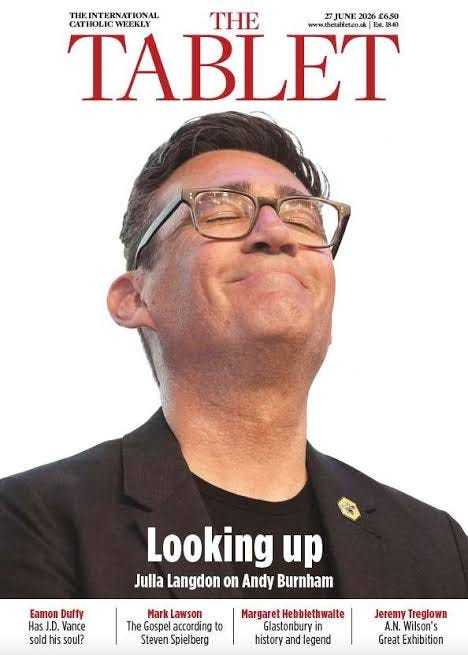
I’d say this cover from The Tablet, so often brave and far-sighted on this kind of thing, struck the most resonant chord with the lapsed, imperfect Catholics I’ve spoken to. They see themselves and their values in Burnham. It’s just what they are, and always will be. Unsurprisingly, that magazine’s former editor Catherine Pepinster has written far more illuminatingly on Burnham and the Church than anyone else I’ve mentioned – this time in the i. She makes the astute point that subsidarity – “encouraging decision-making at local levels” – is at the heart of both Manchesterism and Catholic social teaching. And there’s some nice stuff about the late Labour MP Paul Goggins in there too.
Nick Spencer of Theos is also worth reading. He’s probably right to say in this Church Times piece that Burnham’s faith is “bang in the middle of the Overton Window”. I’m not sure I agree, though, with this: “We would be right to expect something from Mr Burnham’s deep but tame RC sympathies, but nothing radical.” I actually think they’re a large part of the reason he’s started to sound like one. As one Labour peer said to me on the Commons terrace the other night: “He believes.” Supplementary question: “But can he think?”
Since we’re talking about the northwest: I’m very much enjoying Lancashire: Exploring the Historic County that Made the Modern World by Chris Moss.
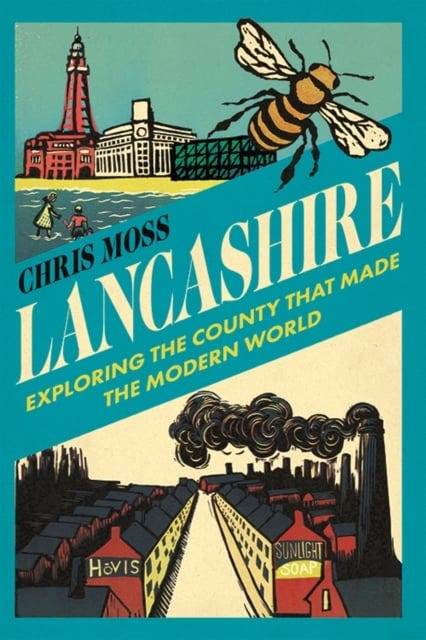
It’s a lovely book, which I’ve been reading in fits and starts for light relief since it was gifted to me six weeks ago. I’d usually agree with James Marriott’s unimpeachable judgement and say this is a terrible way to read non-fiction. But Moss is a travel writer – a Warringtonian who returned home in late middle age after a long, necessarily peripatetic career – and so this tour d’horizon goes place by place, reminiscence by reminiscence. As a reading experience it’s not unlike Bruce Chatwin’s What Am I Doing Here, only a little less flamboyant and far-flung.
As we prepare for the arrival of our first wool prime minister, the early chapters on the in-between towns of south Lancashire that shaped him reward close reading. Nigel Farage once wrote of his own boyhood on the edge of the South Downs: “I just wanted to feel the connection between me and the land, and the people who had come before me.” Moss reminds us that these places, their industries and thus their politics were made by that land: the Mersey, the coal, the salt.
The sense of loss of which those people often speak these days makes more sense once you understand just how pioneering their towns once were. The chapters on Warrington and St Helens are a long compendium of firsts. The former was the first paved town in England. That somewhat underwhelming distinction brought to mind a very funny line in John Campbell’s life of FE Smith, which undercuts his elaborate testament of childhood poverty by pointing out his parents owned one of the first two telephones in Birkenhead. Imagine those calls.
But back to Lancashire. The Sankey was the world’s first modern canal, and, like the locomotive traction pioneered at Rainhill, made loads of the other great industrial firsts – Warrington soap and wire, St Helens glass – possible. Moss is right, as much as the subtitle might read as parochial chest-thumping. This stuff – these places – really did make the modern world. But, as Keir Starmer said in a speech the other week, they don’t make soap in Warrington these days. They’re turning William Lever’s factory into something that might make the modern world anew.
Now, you may not know this, but for centuries, Warrington was at the forefront of Britain’s soap-making industry. And until a few years ago, a Unilever factory was its epicentre. Generations of local people worked there. Families built their lives around it. And for over 130 years, the smell of soap from that factory was a familiar part of daily life. But then it closed. And for many people in the town, that factory became a symbol of a community left behind. But today, I am pleased to tell you that story is changing, because that factory is being transformed into a new AI data centre.
Hmm. Not quite the same, really, is it? Much smaller headcount, for one. It was interesting to see Andy Burnham’s advisers kicking back against this thinking in the FT. They said: “Unfettered tech-boosterism is a vote-loser.” Then: “We do need data centres, but we need to think about who runs and owns those data centres… There has to be a framework for accountability and making sure that 100 per cent of data centres aren’t owned by foreign companies.” Of driverless taxis, they added: “What’s the point and who’s it for? What’s your plan for dealing with the constituency of people that will be impacted by their introduction, including black cab drivers and Uber drivers?”
All of this reminds me that I still haven’t finished Captain Swing, a now neglected but beautifully written work of English history by Eric Hobsbawm and George Rudé. Swing was the pseudonym adopted by the authors of poison pen letters written by rioting agircultural labourers who smashed up threshing machines in the early 19th Century. Sample line: “They did not even sell their birthright for a mess of pottage. They simply lost it.”
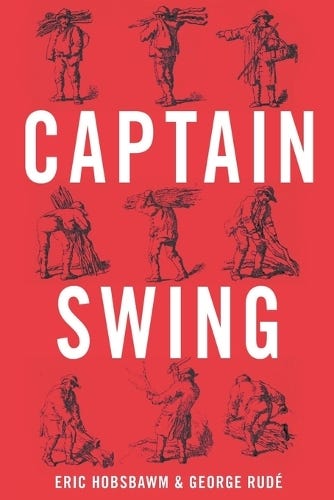
God, nobody writes like that anymore. I picked this up in Hay-on-Wye a couple of months ago precisely because it made me think of the changes artificial intelligence is wreaking on the labour market, and how the forcibly unemployed might end up reacting. Only last week a union leader told me 1,500 of their members had lost their jobs to AI in a fortnight. Already you can see how this might become a generational dividing line in Labour politics.
Captain Swing – or at least the chunk of it I’ve read – will also make you think about welfare, which has a much longer history in Britain than Labour’s folk memory implies. Hobsbawm is especially interesting – and, if you read it today, bitterly resonant – on what the Poor Law did to the rural workforce, for so long a “a bold peasantry, a country’s pride”. Technological change and parish handouts made them “servile, broken spirited and severely straitened in their means of living”. One for me to finish and you to start in pursuit of a longer view on all of this.
Now listen
Alternatively, you can join me and Steve Swinford in the present. We recorded another episode of The State of It yesterday and did our best to convey the manic depression of a Labour Party in purgatory.
Apologies to the learned friend of mine who texted me the other day with an instruction to stop quoting Edmund Dell – “he was, in reality, quite a marginal figure”. In this one I quote a source citing Edmund Dell as evidence for why Burnham should retain more of Starmer’s cabinet than he might immediately be inclined to.
A couple of hours later, a minister texted to tell me they were reading Edmund Dell’s A Strange, Eventful History: Democratic Socialism in Britain. They were the second to send me a nice message about Edmund Dell this week. He’s not marginal anymore! I might have to rename this Substack for a second time. The Burnham Magnanimity Syndrome outbreak is over. Edmund Dell Syndrome is Westminster’s new public health crisis.
Like the newsletter a lot Patrick. Particularly happy to see Hobsbawm and Rude’s excellent book discussed.
Just on McSweeney, how odd was that interview with Nick Robinson? Almost impossible to reconcile the compelling, driven and highly intelligent character of ‘Get In’ with the nervy U2 lover who was barely able to muster a defence of the project…
Always love your comment pieces - and often miss them. So this is a great way of catching up. Thank you