Such a thing as Starmerism?
Weekend notebook: 25th July 2026

Good morning. Three weeks and a day ago I promised you a notebook on my reading and writing every Friday morning. It didn’t take me long to break that contract, but hey – at least I tried. And in politics, being seen to try is nowadays more than half the battle.
That’s something Andy Burnham told me last weekend. He knows the policies he has announced since taking office on Monday won’t provide “overnight” solutions to the cost of living crisis. “But you’ve got to show people where we’re going, and then the steps towards it. And that’s what I’m going to try to do.”
So please try to take this one-off Saturday notebook in that spirit. Apologies to all.
Anyway, you won’t be surprised to read that my column in yesterday’s Times was about the first four of the prime minister’s first 100 days – and what they might tell us about the coming 96.

The first thing I should say about this piece is that the headline tells only part of the story, which is about the what and the how of Burnham’s plans for office.
In my many conversations with Labour people of varying loyalty and emotional stability this week, there has been one point of consensus. This prime minister, unlike the last one, is crystal clear on the what of government. By extension, he’s just as unambiguous on the why.
The point of this government is to provide what mitigation – “breathing room” – it can possibly give within the confines of the 2024 manifesto in the short term. In the longer term, as per his plan for a “ten-year plan” he promised The Times and then the country in the space of 24 hours last week, it is to remake the British state entirely.
Once that’s eventually done, he argues, cheaper energy and bus fares and ever lively flat-roof pubs can be permanent fixtures of a democratised, thriving economy. So there it is – the what, and the why. How about the how?
The answer to this one comes in two halves, and is best told from inside No 10 – or at least its London branch office. Reshaping the state is both the ends and the means of this political project. The way Burnham is doing so is a little paradoxical. He’s all about devolution and decantralisation, yes. But he’s started by concentrating as much power as he can in his own hands.
It’s best understood via Antonia Romeo’s new desk. The cabinet secretary now has a seat in the outer office in No 10 – right outside the prime minister’s study. It’s the Sandbanks of political real estate: a hyper-exclusive compound of pure power. I asked some of her predecessors whether this was usual practice. They said no. Indeed, the fact the sight surprised people in Downing Street is how I ended up finding out.
As I write in the column:
Antonia Romeo has a new desk. And while the cabinet secretary’s grand designs for the British state go well beyond office furniture, this small point of reorganisation tells us quite a bit about Andy Burnham’s young government. As of this week, Romeo has her own seat in No 10’s outer office: the most exclusive patch of administrative real estate on Downing Street. The head of the civil service can work — will work — from just outside the prime minister’s study, whenever she pleases.
As one grand old man of Whitehall notes, not even Jeremy Heywood, the most formidable cabinet secretary of recent history, ever pulled a move like this. But Romeo’s desk in No 10 is the very essence of this new administration and how it intends to reclaim the power that bled slowly from Sir Keir Starmer’s office over two torturous years. The first and most important principle of how our new rulers want the state to work is now simple enough. It’s all about Burnham.
So why is she there? There’s no better testament to Romeo’s generational talent for office politics than the fact that her colleagues always mention it, a bit like Burnham’s uncommon ability to position himself in the right place at the right time. It’s sometimes a compliment, sometimes an insult, but it’s never denied. She’s there because the real power in the land is there, and she wouldn’t want to be anywhere else.
But that’s happened by design. Burnham and Louise Haigh have reinvented the centre of government – both No 10 and the Cabinet Office – as an ocean-going engine room of pure politics. My column quotes a message from Dan York-Smith, the prime minister’s principal private secretary, in which he explained to Downing Street staff that they’d now find a “smaller department” on the 70 Whitehall side of the link door between No 10 and the Cabinet Office. And as I’ve written before, No 10 North is less an outpost or gimmick than a prime minister tank on the Treasury’s lawn.
Back on Whitehall, Haigh is no longer responsible for the big state bureaucracy and administrative AOB that Cabinet Office ministers had to own in the past – most of that has been hived off to OneGov, a new agency that’ll handle HR functions, government cars, vetting, IT systems and the like. What’s left is, in York-Smith’s words, that “smaller department focussed on the policy and secretariat functions which support the PM and Cabinet”. And No 10, both north and south, is now home – at last – to a proper Office for the Prime Minister and Cabinet. As I wrote yesterday, the machinery of state is now all about Burnham.
Before I go on, a brief apology to the late Jeremy Heywood. You’ll have seen I noted the awed – and a little concerned – reflection of one Whitehall veteran on Romeo’s desk move. Not even Jeremy – formidable, all-powerful, indispensable Jeremy – pulled that kind of stunt, they said.
Helpful clarification landed on Friday morning, via iMessage. A survivor of Gordon Brown’s No 10 wrote to say:
Remember Jeremy Heywood actually put his desk NEXT to Gordon’s in the War Room built in No 12… Antonia has not quite managed that. I’m sure it won’t be long.
As ever with memoirs of that premiership – even those that are sentences long and published only in texts – there was some delightful supplementary colour.
The key thing we got wrong, of course, in that set up, was allowing Gordon to put a massive telly on the wall opposite his desk, permanently tuned to rolling news.
But back then Heywood was Brown’s chief of staff – Gus O’Donnell was cabinet secretary. Come 2010, of course, Jeremy became No 10’s permanent secretary, a post that died a death in 2012 before abortive revivals under Boris Johnson and Rishi Sunak. Where did he sit then? That’s probably the more relevant question.
Still, a great story.
The other half of the how
No amount of organising and reorganising can save a leader who can’t do the politics. Sir Keir Starmer could have told you that. And if there’s one big unresolved question from week one of the Burnham era, it’s this: can he put this broken Labour Party back together again, or has he inadvertently botched the restoration job like that poor octogenerian who tried to spruce up the fresco of Jesus in Borja?
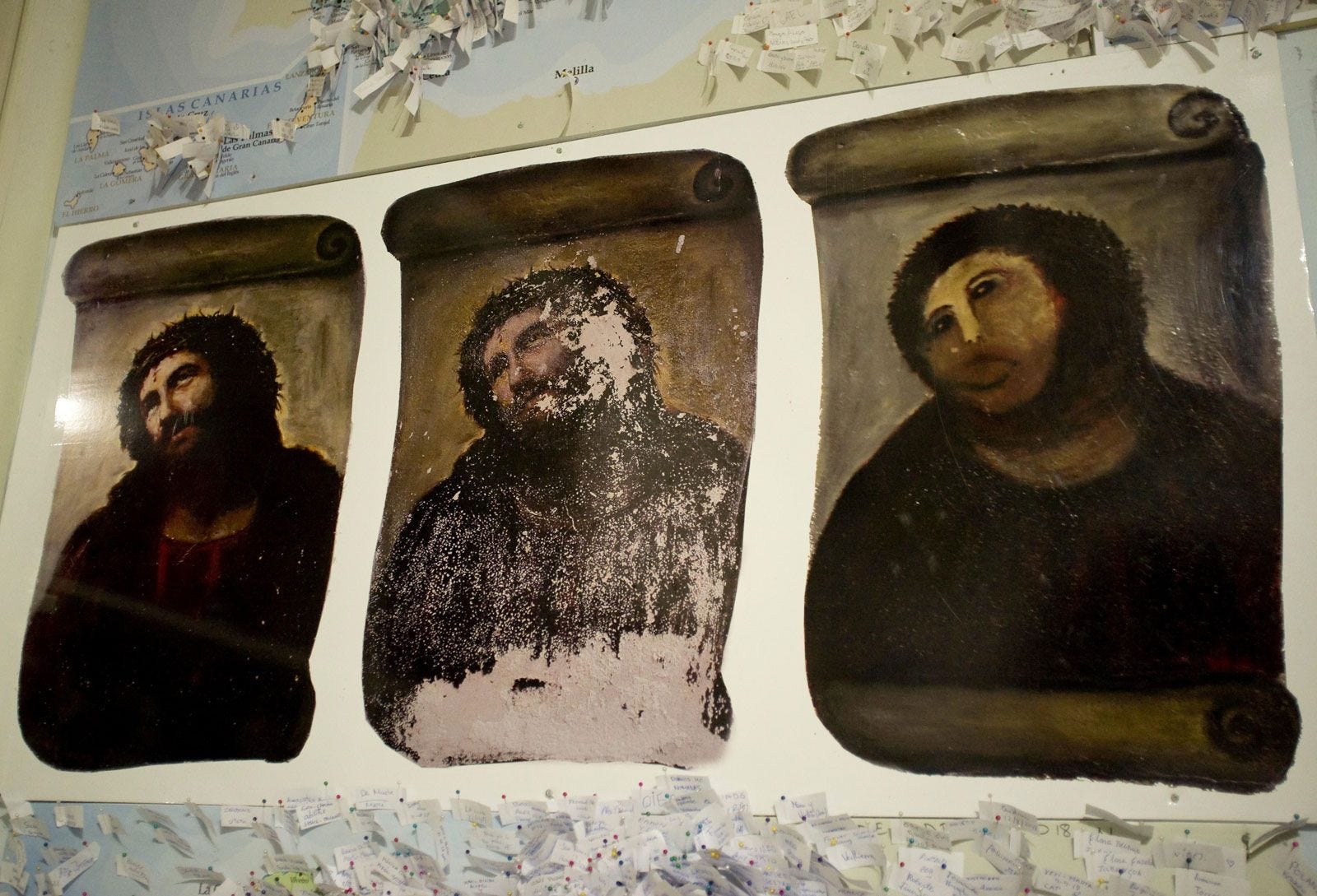
Burnham’s team hope a nice, long summer break and the eventual return of angry MPs to the loving embrace of a prime minister who’s prepared to treat them like human beings will, in the end, soothe the tempers that have flared so dangerously this week.
But there’s no question that lots of people are upset to the point of nihilism, and not just the Starmerites. Some of the grumpiest backbenchers I spoke to this week were those who backed Burnham early, did their time at Stubshaw Cross, got nothing, and consequently feel let down and screwed over. There’s a big job of work to do now. As the new PM told his new cabinet on Tuesday, these people must be part of the team – and it’s on the cabinet to make them feel integral.
Thus far, the losing side complain, the extent of magnanimity in victory seems to have been limited to a long and heartfelt text from sometime Jacinda Ardern strategist Hayden Munro, Burnham’s political secretary – excerpts from which I published in The Times:
Just on a personal level, as someone who’s been on the other side of this kind of transition back home, I just wanted to say to those of you that have been grinding at this for the last two years: we’re so glad you’re with us. I want to be really clear about this: the only thing I care about is getting this government re-elected. If you’re part of that mission, you’re my comrade and let’s do this.
That passes what I called the Jimmy Reid Test of party management in a post on here the other week: no vandalism, no hooliganism, no bevvying. Ask a Labour MP or special adviser and they’ll tell you that aspects of this transition failed it. There’s time yet to prove otherwise. Steve Swinford and I set out the state of play in the political read in Saturday’s Times if you want more on what’s winding them up.

Actually existing Starmerism
One final thing on what this week has done to the Labour Party. Has the impossible happened? Does Sir Keir Starmer now have a faction of his own? That was the conclusion of one of his closest allies on Monday evening. They texted me with this very cute observation: Starmer never had a faction of MPs, but Burnham’s first set of appointments might well have succeded in creating one for him.
Put this to the victims of said process and there is a kind of polite disagreement. They identify with that label, up to a point, but would much rather say their only crime was loyalty to the leader of the Labour Party and the embattled government he led. Now they are jobless and the rebels prosper handsomely.
To that, though, the rebels not unreasonably point out that the price of that loyalty – to a singularly unpopular, lose-lose-lose leader almost everyone, including said loyalists, acknowledges was pretty useless as a politician – was Labour’s electoral viability. I find that rebuttal pretty hard to argue with.
This scratchy debate kicked off in earnest when Darren Jones denounced Burnham’s abolition of VAT on energy bills as an unfunded splurge on Tuesday morning. I understand he’ll have much more to say on this theme in September. You can be sure that cabinet refugees like Steve Reed will be up on their hind legs too. Nor, I’m certain, will Rachel Reeves want to fade into obscurity either.
What they say will end up being called Starmerism anyway, even though friends of the recovering PM say he is anxious to avoid people lobbing grenades in his name. After all, he did once say – as Gabriel Pogrund and I revealed in GET IN – that there was “no such thing as Starmerism, and there never will be”.
I’m sure the new guerrillas will point out that their objections are principled rather than personal once hostilities commence, too. From a few conversations on this theme this week, I expect – once the casualties regroup – they will weaponise the following and more.
Fiscal responsibility. See Jones.
Europe. Particularly if growth still struggles for signs of rude health. Charles Grant of the Centre for European Reform noted that cabinet evangelists for closer ties with Brussels mostly lost out – as did Nick Thomas-Symonds, whose old Cabinet Office negotiations brief appears to have been gobbled back up by the FCDO.
Immigration. Particularly the impact of asylum hotel closures on Burnham’s rough sleeping mission.
Devolution. Every scheme will have its discontents, and there are dispossessed Labour MPs to be found everywhere. Local government reorganisation was unpopular in the PLP anyway, as I wrote last year.
There’s your starter for four, to which you can add broader, vaguer criticisms of loyalty, competence. All in all, it could be quite an intellectually energising time for a section of the Labour right. Just how publicly they enjoy it will depend on how much they really value that loyalty thing.
Now listen
It was another two-episode week for The State of It, our Times and Sunday Times podcast. On Tuesday we ran the rule over the reshuffle and painted a picture of Starmer’s leaving do.
Friday’s installment looked back on what exactly the new team in No 10 was trying to achieve, and whether they succeeded.
I was also on Newcast with Adam Fleming and Lucy Fisher from the FT. Listen to that for what Burnham can learn from the unforeseen challenges of Gordon Brown’s first days in No 10, and a bit of insight on what Nigel Farage has been up to while hacks have been looking the other way.
The full story of the week that was
As told by me in The Times:
Sunday: Andy Burnham’s last interview before entering No 10.
Monday: What to make of a surprising, brutal reshuffle – and John Healey as chancellor.
Thursday: Remaking the state, with a view from inside a divided No 10.
Friday: ‘Andy Burnham’s chaotic first week is over. Here comes the hard part.’
Something completely different
I loved the obituary for Kevin Keegan in The Times. It occured to me as I read that he was so embedded in the demotic of British culture – I would love it, etc, etc – that I knew much less about him than I should. For those of us born towards the end of the last millennium, and particularly Liverpool fans, he was always there, in the folk memory we inherited, but we never got to see him at his pioneering, fearless best.

So on Thursday I picked up a copy of Anthony Quinn’s slim little biography (or maybe panygeric) from earlier this year. Keegan: The Man Who Was King is barely more than 200 pages long and is thus far an uncomplicated delight to read. Quinn turns a beautiful phrase and manages to convey so much anyone reading this Substack would want to know about the social and economic history of football – and Keegan’s role in shaping it – without ever being windy or boring.
This passage on his first contract negotiation at Liverpool is such a fine example. Not a word wasted.
The only hiccup to the transfer came when they sat down to talk money. Shankly was offering him £45 a week, but Keegan, his dad’s advice tolling in his head (‘Don’t sell yourself cheap’), had a disappointed air. He claimed to be already on a decent wage at Scunthorpe. Shankly asked him whether £50 a week would be acceptable, and the deal was done. The raw recruit, still only twenty, knew his own worth. From that point on he would run his affairs and look after his money with a shrewdness not common among footballers.
Quinn portrays Keegan as George Best’s natural opposite when it came to work and thrift, even though he too was a spontaneous, instinctive player who agreed with Joe Mercer that football should be “a game of pleasure”, and also with Bill Shankly, who described it as a simple game complicated by coaches/idiots/people who should know better.
If you were to serialise the first chapter of the book as a newspaper feature, though, the headline would surely be something like Kevin Keegan: Thatcherite – really he was a lifelong Labour man, the son of a Doncaster miner, but you know what I mean. Maybe Kevin Keegan: Sole Trader is better. As Quinn writes: “He negotiated his own contracts, secured sponsorships, even arranged his own transfers. In an age when footballers were still under the thumb of chairmen and directors, Keegan was out on his own as a businessman.”
When Bobby Robson took over as England manager in 1982, he summarily dropped Keegan from the squad – much to his disappointment. Keegan found out from the papers. “I felt I deserved a phone call,” he said. “It would have cost Bobby Robson ten pee to phone me up at Newcastle.” Then a lovely, funny line from Quinn: “Strange that even a phone call is costed in Keegan’s universe.”
On the subject of office layouts, perhaps Burnham should bypass the Government Art Collection and request Kenny Hunter’s red fibreglass bust of Jimmy Reid in the collections of National Galleries of Scotland. Or maybe not.
Interesting note, cheers Patrick!