How not to be helpful
Why Labour Together's leadership survey matters


On the front page of today’s Times – get yourself a subscription to read the story in full – I uncover yet more evidence that the Labour Party is preparing for life after this prime minister. Here’s the top line.
The influential think tank that ran Sir Keir Starmer’s leadership campaign is canvassing party members on candidates to replace him.
That influential think tank, of course, is Labour Together. If you’ve read Get In – and, if not, it’s discounted in time for Christmas gifting – you’ll immediately realise why the central fact of this story struck me as so significant when it dropped into my WhatsApp yesterday lunchtime.
Labour Together, as we know it, is Morgan McSweeney’s creation. It was the laboratory in which his Changed Labour Party (which recently died much too young in a tragic budget accident) was grown. Funded by donors with a tribal attachment to Labour but a stronger aversion to Corbynism, he spent the years between 2017 and 2019 doing something never before done properly: polling the party membership.
As another LT alumnus told me after this story dropped last night, it taught McSweeney several things he had hoped – and others on the Labour right suicidally persisted in believing – were not true:
Most members wouldn’t listen to a “principled stand” against Corbyn. They agreed with his principles. Indeed, that’s why many of them joined.
At the same time, those same members were not all – to quote a brilliantly evocative and representative insult from Dan Hodges in 2015 – “three-quid-dog-on-a-rope-rent-a-Trots”. Labour’s centre of gravity remained quite firmly rooted on the soft left. The party had been not overrun by Marxists and extremists.
New members were unlikely to join in order to demonstrate their opposition to antisemitism, or otherwise “take back” Labour from the left for some other reason.
These were inconvenient truths – signposts pointing somewhere very few Corbyn critics could bring themselves to go. The polling showed that ousting the leader by force or an influx of new members was a non-starter. But leaving altogether on the grounds that the Labour Party had become the SWP would be similarly stupid. They were going to have to speak to the membership as it actually existed, on its own terms.
Given what we now know to have been the true, oxymoronic purpose of Labour Together – dividing the membership from the organised left – the group started to talk expansively of unifying values, rather than ideological dividing lines. With brazen, calculated disingenuousness, McSweeney even went to show the polling to Corbyn in April 2019. Gabriel Pogrund and I opened Get In with an account of their meeting.
He says he’s here to tell Corbyn about something called Labour Together. It sounds unthreatening. Labour Together. That’s the kind of ethos Jeremy likes. In the press, and in the parliamentary bars, they call him a Stalinist. But really he hates conflict. He can’t bear to hear his critics accuse him of antisemitism, or read of himself villainised as a friend of terrorists by the newspapers. So when Morgan McSweeney arrives to tell him about Labour Together, he has nothing to fear. . . He talks the leader through some polling, the most detailed ever conducted on the half a million grass-roots members that are Jeremy’s pride and joy. Labour Together knows what they think of Europe, of economic policy, of Corbyn himself, and they’re happy to let him have the data for free.
The many pretenders to Corbyn’s crown also had sight of it: almost everyone was mulling a post-election leadership bid at the time. Few really seemed to understand what the data meant. Nor could they stomach the tactical accommodations with the left it implied were necessary. But only a couple of months later, Starmer had made the numbers – and McSweeney – his own. Or, perhaps, the other way round. Get In again:
For two years he had imagined a silhouette, its exact profile as yet indistinct. They would need to be known by the members but they could not be a Corbynite. At the same time, they could not be a rebel. Above all they could not be honest about their ambition to replace the incumbent leader until the very moment of release. One July afternoon in 2019 the profile’s features at last resolved into clear view. The candidate was Keir Starmer.
All of this is to say that Labour Together was once Keir Starmer, and Keir Starmer was once Labour Together. He needed a machine, they needed a candidate, and the transaction repaid both parties handsomely. In 2023, as the once implausible prospect of government became real, Labour Together reinvented itself as Westminster’s only Starmerite think tank. Now it’s offering grassroots members the chance to win a £500 cash prize to rank his chances of winning an election relative to Darren Jones, Lucy Powell and Andy Burnham. Is it all over?
The Labour Together line on their survey – which, I’ve since learned from activists, has been very badly received in some of the Constituency Labour Parties who’ve been nudged to distribute it to their members – got an airing via the former Starmer aide Luke Sullivan on Times Radio this morning.
In the light of day it doesn’t look great, but the explanation from Labour Together is that, essentially, they are very interested in knowing what the views are of Labour Party members, and there’s a whole host of questions they have asked that they’re seeking to get a benchmark on to understand what the opinion of Labour members are. The line from Labour Together is that they are trying to be helpful, that they are trying to share this with Number 10 and that this will help them persuade Labour MPs and the party to do difficult issues such as welfare and the SEND reforms that we’re expecting in the new year.
That’s true – I accessed the survey on several devices yesterday and there are lots of questions that aren’t about the leadership. Do you have a degree? Where do you live? Where do you get your news? Did you vote for Lucy Powell or Bridget Phillipson? Should we rejoin the EU? Is the government doing a good job on Gaza, housing, the economy, et cetera? What have you done for Labour lately: knocked on a door, or just shared something on socials? All are helpful things to know if you want to get a feel for the grassroots, though proper polling – rather than a self-selecting questionnaire with cash inducements for completion – would obviously be much more helpful.
What feels much less helpful is this. It’s worth me adding, by the way, that there’s no suggestion this had anything to do with McSweeney – or the many other Labour Together alumni at the top of government.
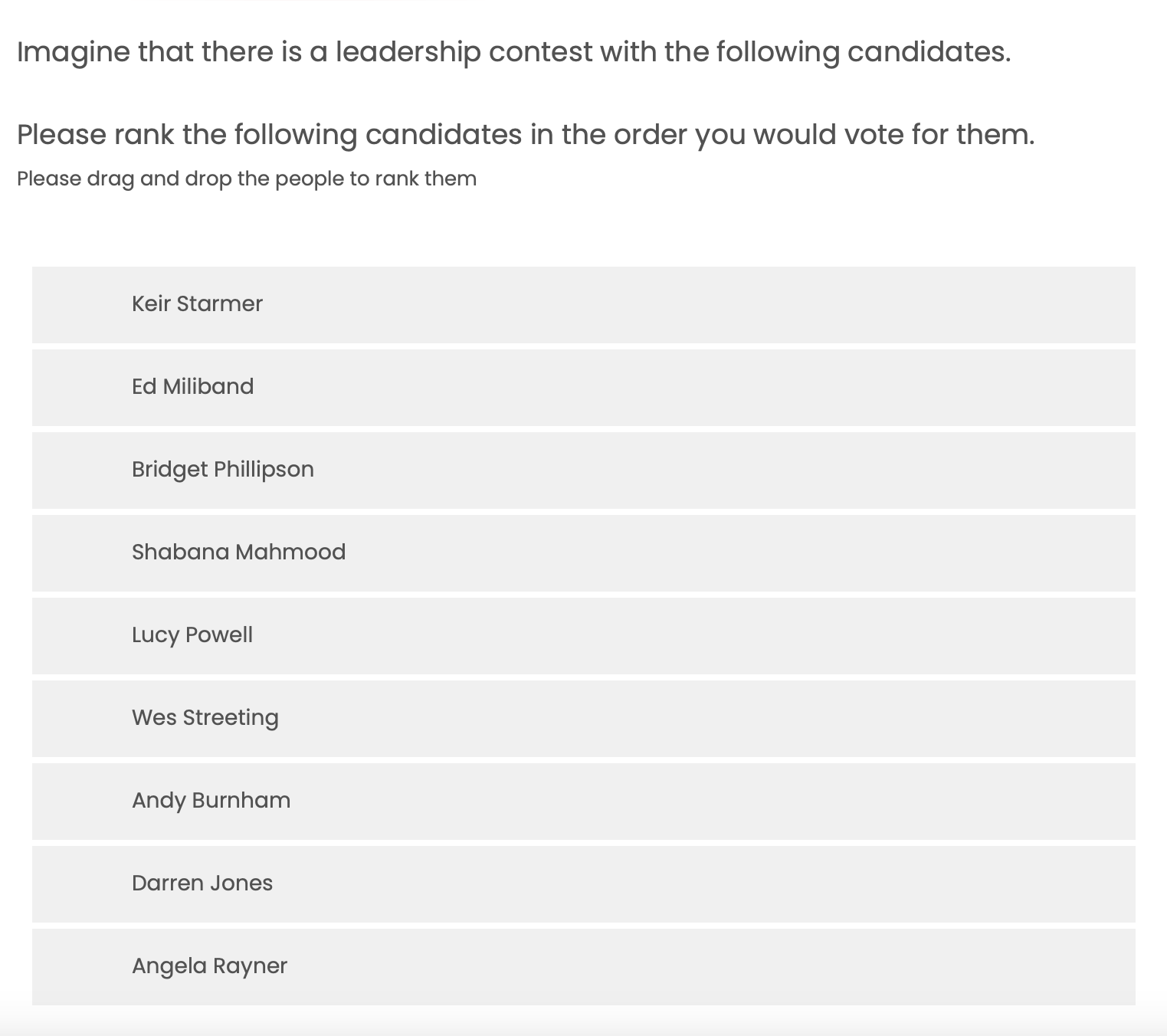
Or this.
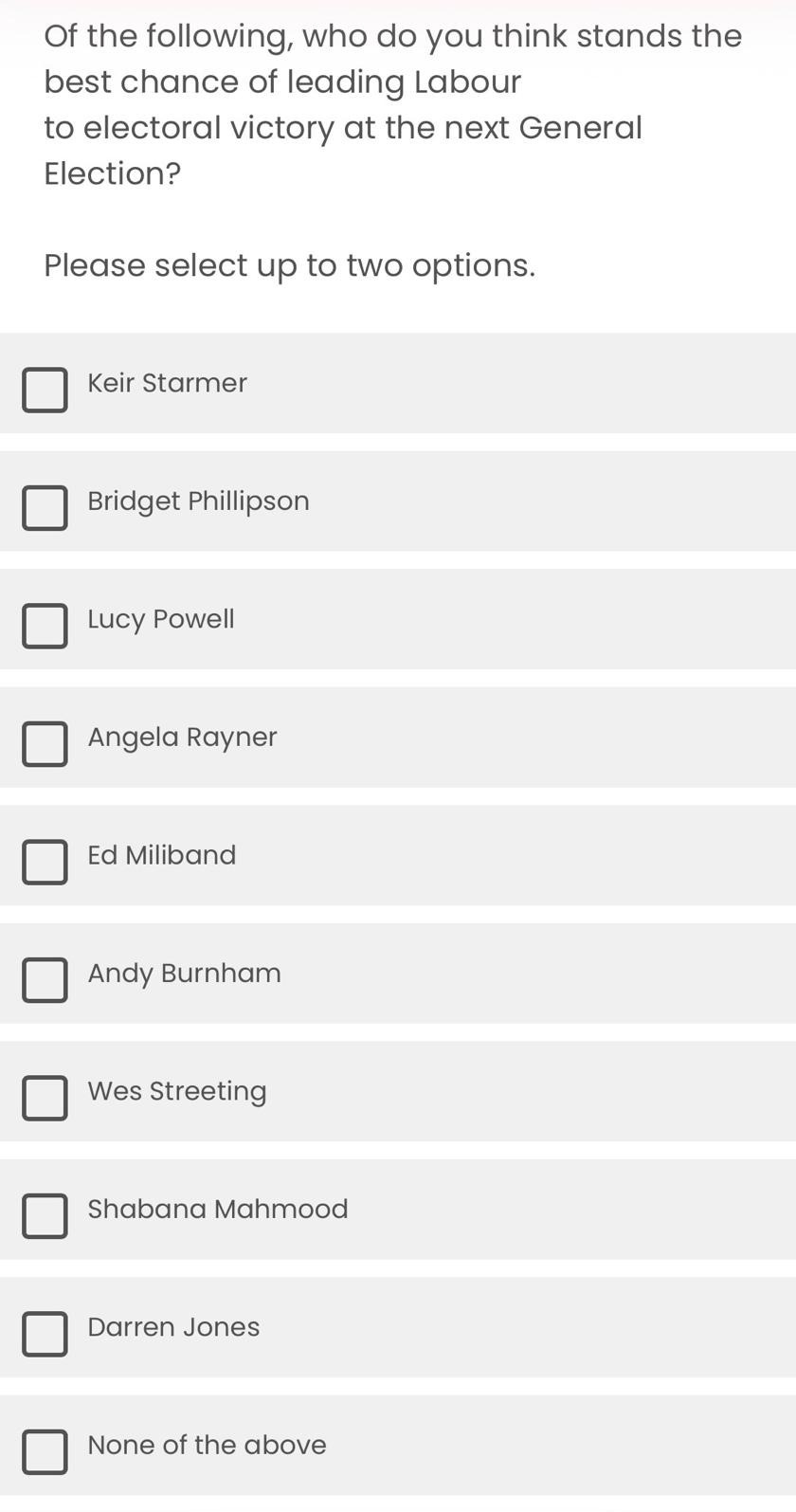
If you pick none of the above or say you don’t know on this one, by the way, it compels you to pick. Helpful! Eventually, depending on your choices, you end up here.
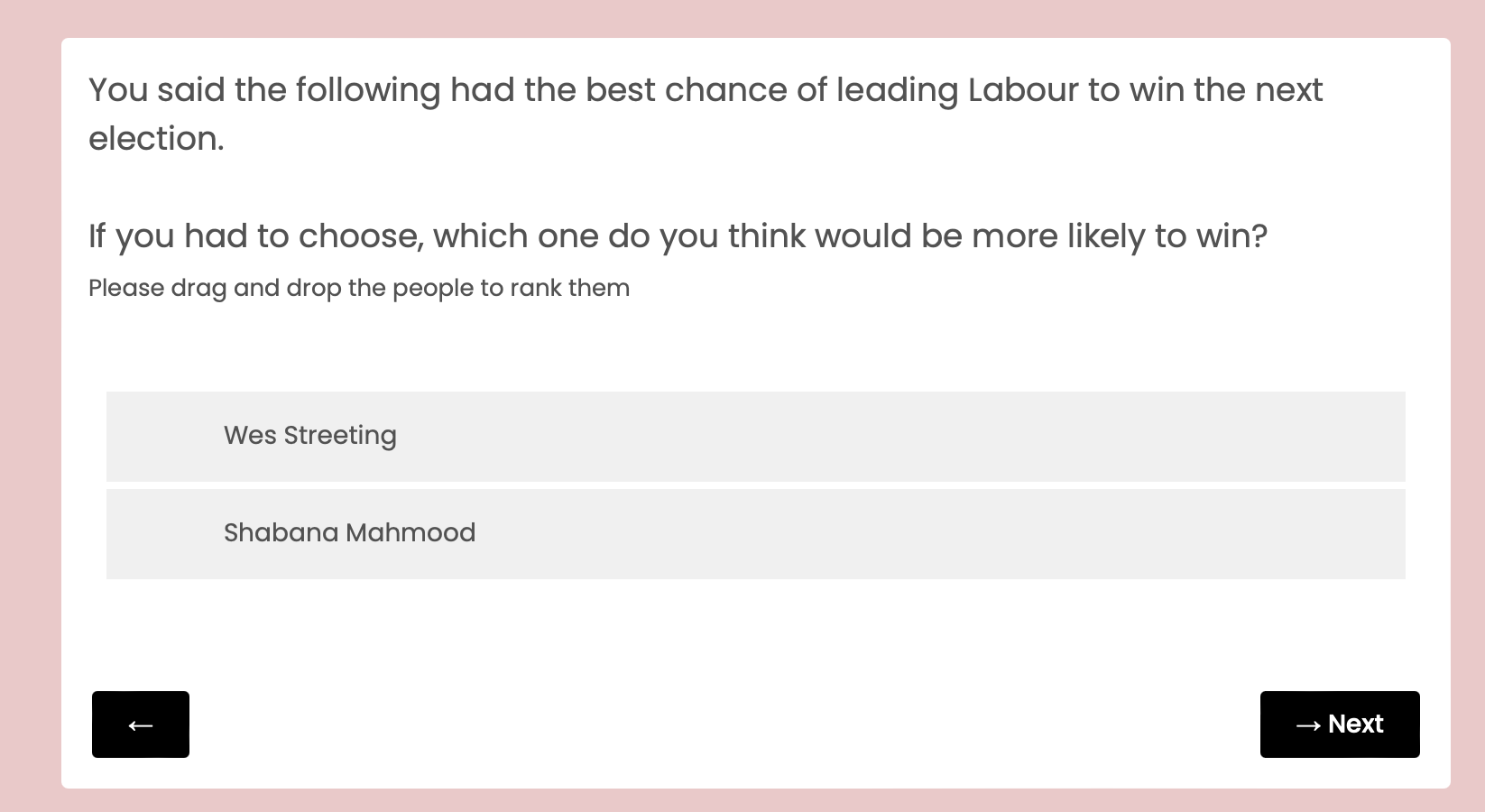
Finally, you’re given a series of hypothetical head-to-heads.
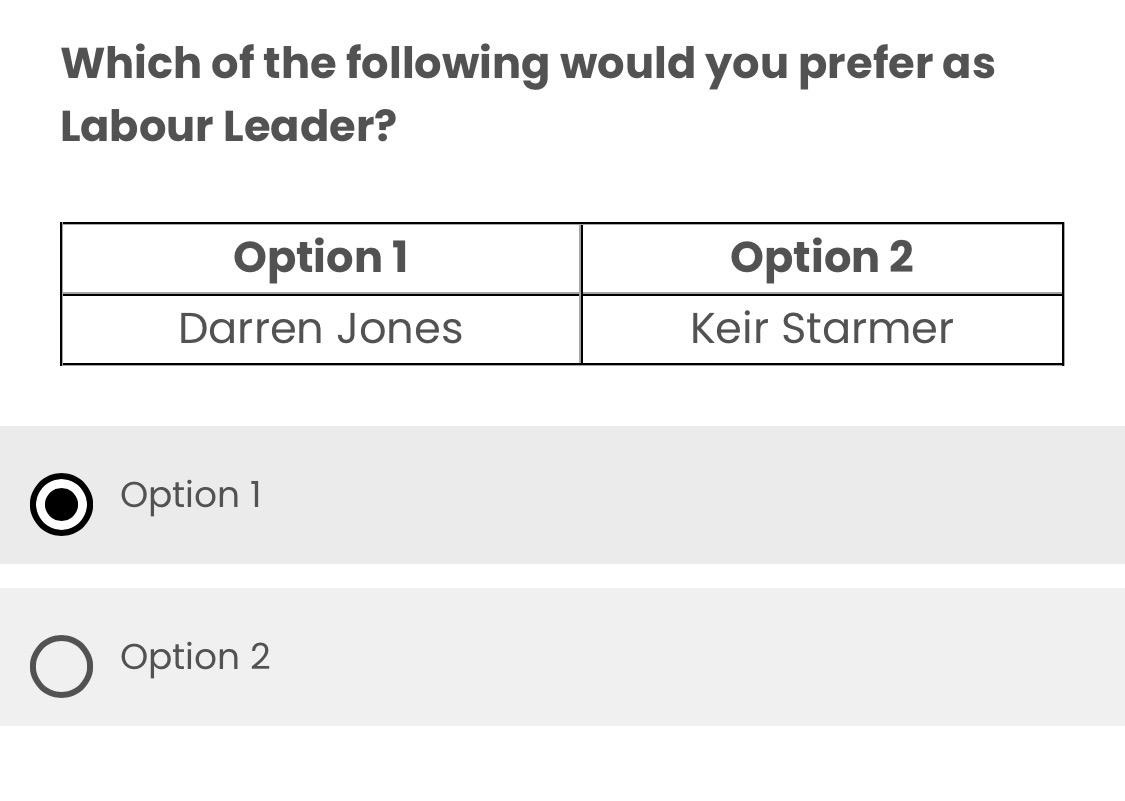
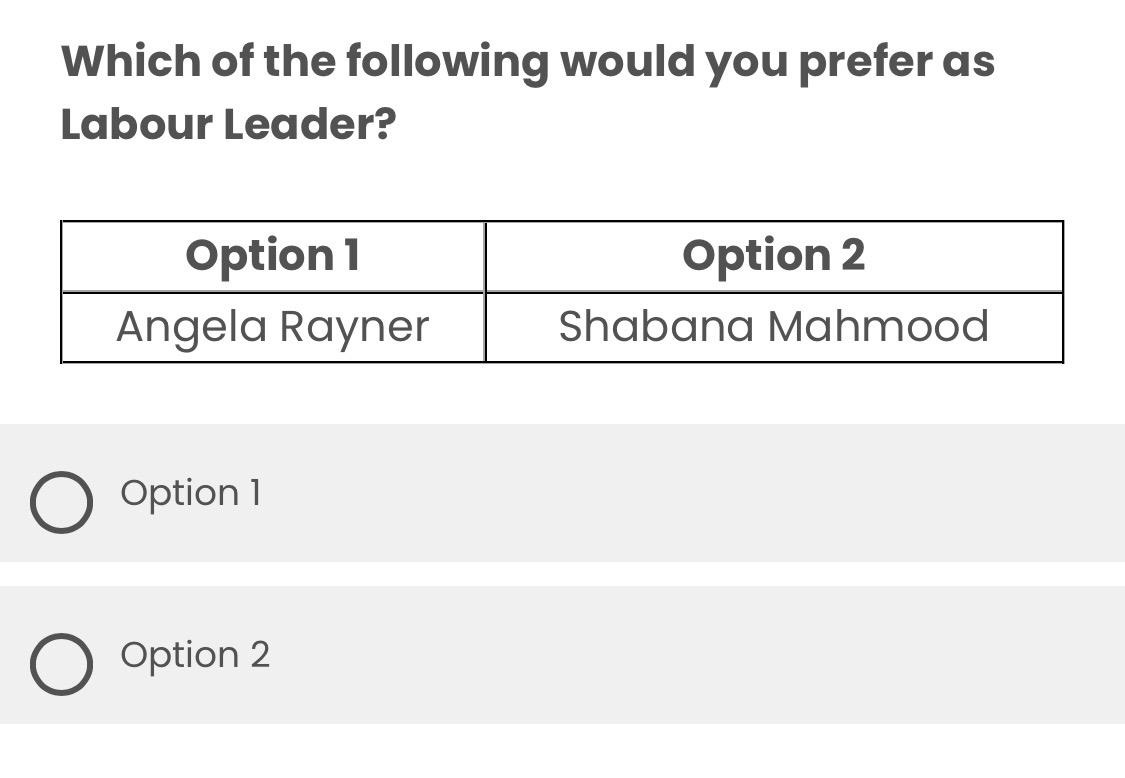
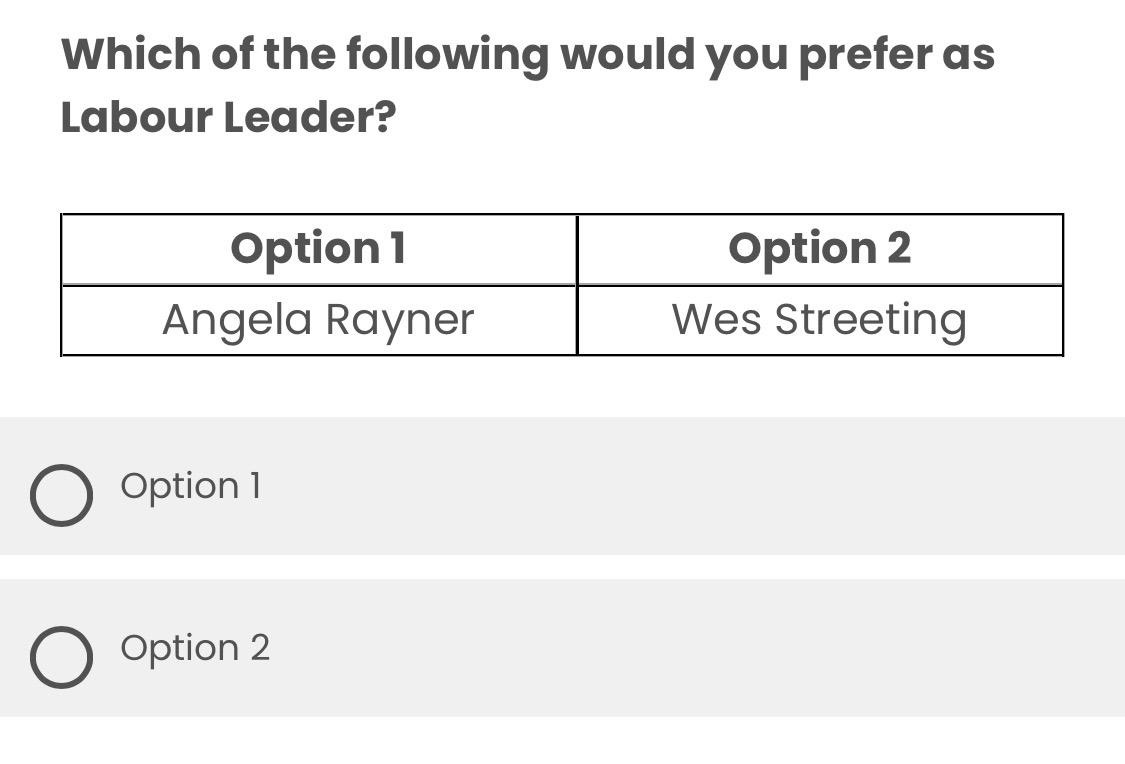
Putting these questions in front of thousands of members at a time when Starmer’s leadership is under threat has turned out to be less than helpful. Inevitably, given how provocative it is for Labour Together specifically to be asking them, they’ve leaked, giving another day’s oxygen to speculation that limits the prime minister’s ability to talk about literally anything else. ITV interviewed him on his visit to McLaren this morning – an event that was meant to focus on apprenticeships, the policy we’re now told is his animating passion – and asked: “Are your chances of leading the country diminishing?”
To that Starmer said he didn’t want to talk about the internal politics of the Labour Party. Which is sensible enough: when No 10 tried that the other week they ended up losing a knife fight to Wes Streeting. But almost nobody else is abiding by his self-denying ordinance – not least Labour Together, described only last year by its then-director as Starmerism’s “provisional wing”.
Given what a couple of Starmer loyalists were saying to me about this survey last night, I expect the self-styled provisionals behind this unauthorised mission might be getting a visit from the nutting squad in due course.
They’ll share the findings with Downing Street, but the damage has been done. Once you’re asking the question, you’re accepting the premise that a leadership election is something No 10 need to worry about. Obviously it is. They’ve said so themselves. But once you accept that Starmer might not be in it – as those final questions of the survey do – you can’t really call it helpful.
Christ, what a shower.